How to Start and Scale a Tutoring Business in Australia (2026): The Operator's Guide

I’ve been running a tutoring company in Victoria since 2026 — deliberately small, as a test rig for ClassQuill, and a live experiment in what it actually takes to start and scale a tutoring business in Australia. Before that I’d been watching tutoring-company owners deal with the same operational headaches for years: admin that ate evenings, parents who cancelled without warning, and no clear view of whether any of their tutors’ sessions were actually working. This guide is what I know from doing it, not from reading about it.
The short version of what you’re in for: seven stages, and most of the common advice gets the hard ones wrong. The stages aren’t all equal, and the mistake most new operators make is solving the easy ones (getting clients) without solving the ones that decide whether you scale (keeping clients and not drowning in admin). Here’s the real map.
How do you start and scale a tutoring business?
To start and scale a tutoring business, work through seven sequential stages: (1) choose a specific niche and delivery model; (2) register your ABN and complete the Australian legal basics — WWCC, insurance, GST threshold; (3) set pricing with a margin that survives paying tutors; (4) get your first clients through referrals, Google Business Profile and a free initial session; (5) systematise scheduling and invoicing before the volume breaks the manual approach; (6) hire and properly contract your first tutors; and (7) build the systems that let parents see their child improving — because that is the retention lever, not good admin. The guide below walks each stage with specific numbers for Australia.
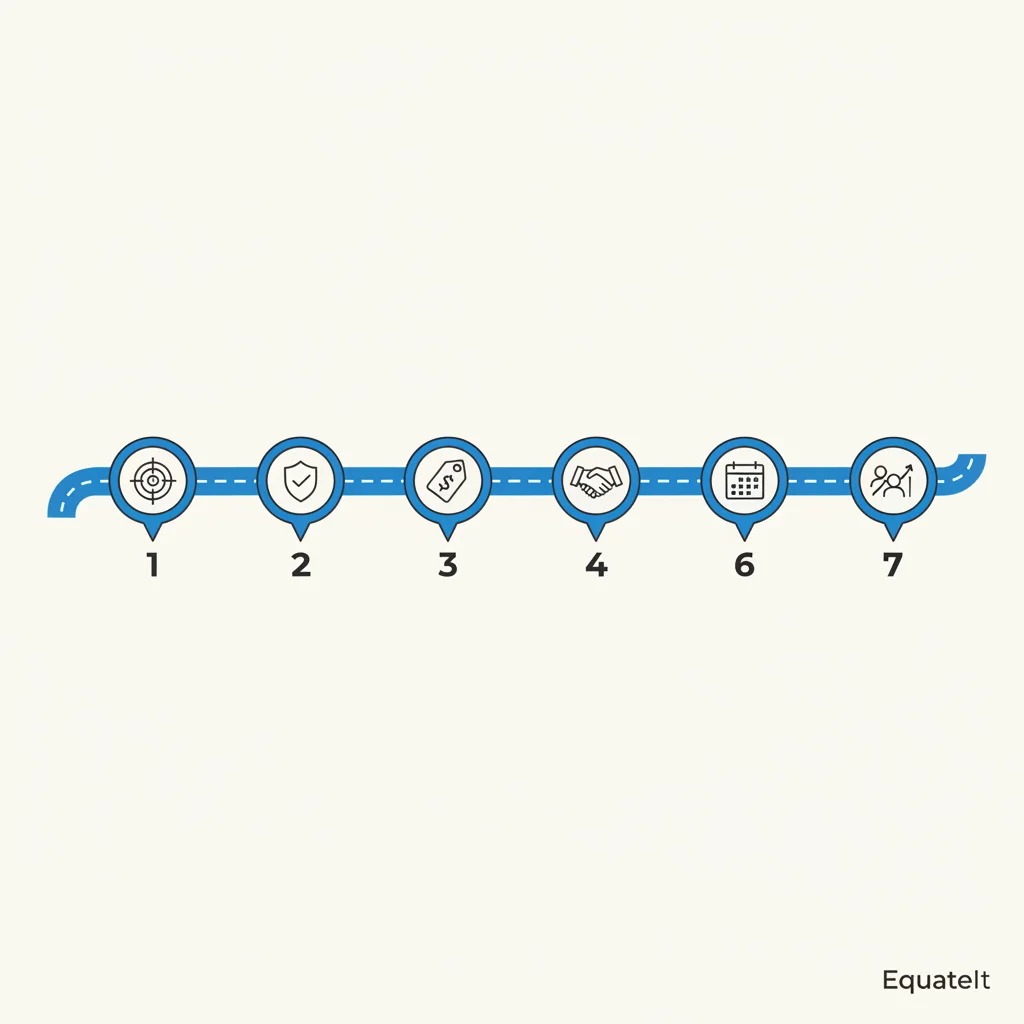
Stage 1 — Niche and model
The fastest path to your first client is a niche narrow enough to be findable and credible. “Tutoring” is not a niche. “VCE Maths Methods and Specialist in Melbourne’s eastern suburbs” is.
EquateIt started with VCE maths — Methods, Specialist, and Further — for two reasons. First, the demand-to-supply gap is sharpest there: VCE specialist subjects command $75–$130/hr in Melbourne because genuinely qualified tutors are scarce. Second, it’s what the team knows directly. I did Methods and Specialist myself; Will (co-founder) scored 99.65 with top marks in all three maths subjects and tutored for three years. Starting in a niche we’d lived meant confident answers for parents from day one, not after six months of figuring it out. What would I choose differently? I’d define the geography even tighter earlier — “eastern Melbourne suburbs” not “Victoria” — so the marketing was more precise before we had reviews to support broader claims.
In-home vs online. Both work; each has different economics. In-home commands a $10–$20/hr premium over online — parents pay for the convenience and accountability of a tutor arriving at the house. The trade-off: your capacity is capped by geography and travel time. Online removes the cap and makes it possible to work with students across the state (or beyond), but the premium disappears. EquateIt runs both: in-person for families in our immediate area who specifically want it, online for everyone else, including students in regional Victoria where in-person options are scarce or non-existent.
Job or business? This is the question most guides avoid. If you tutor yourself, you’re buying yourself a $60–90k/yr salary in Melbourne at current rates — and hard-capping there. Your hours are the ceiling. If you’re building a company where other tutors do the teaching, you earn the spread (typically 25–35% of what you charge families) but you now have to recruit, manage, and retain tutors. The two paths need entirely different things from day one — operations, contracts, compliance, systems. Know which one you’re building before you start.
Stage 2 — The Australian legal basics
Get these sorted before your first paid session. None of them are complicated, but all of them catch new operators off guard.
ABN. Register at business.gov.au{target=“_blank”} — free, takes ten minutes. Most operators start as a sole trader (your personal ABN). If you’re running the company with co-founders, look at a separate partnership ABN for the tutoring business rather than mixing it into one existing ABN — it keeps the books cleaner and makes future restructuring simpler. This is worth a 30-minute accountant call before you take real money.
Working With Children Check (WWCC). In Victoria, every paid tutor working with minors needs an Employee card — not a Volunteer card. An Employee card costs $131.60 (2026 rate — the fee is set each financial year on 1 July) and is valid for five years. This is your first compliance gate. Sort it for yourself and every tutor before any session happens, no exceptions. Other states have equivalent requirements with different names and fees, but the obligation doesn’t vary. (Free tool: WWCC compliance checklist → to track who’s covered.)
Public liability insurance. Essential for in-home tutoring — you’re in someone else’s house. A standalone policy for a small operator typically runs $500–$800/yr. Ask your insurer about Professional Indemnity as well if you’re providing academic advice or guaranteeing outcomes.
GST. You don’t register until you exceed $75,000 annual turnover. Private tutoring is not GST-exempt (unlike services delivered by registered educational institutions), so once you cross the threshold, you’re collecting and remitting 10% on every invoice. Don’t wait until you’re close to understand the obligation — the invoicing change needs to happen precisely at the threshold, not retroactively.
Stage 3 — Pricing and margin
→ Deep dive: How much should you charge for tutoring? →
The Australian market averages $64/hr nationally for all tutoring. In Melbourne, VCE specialist subjects (Methods, Specialist, Chemistry, Physics) run $75–$130/hr. Online tutoring sits roughly $10–$25/hr below the equivalent in-person rate.
If you’re running tutors, you need to price for margin from day one. Repricing existing clients later is painful and often triggers cancellations — set the right rate upfront.
A simple model that works: pay your tutor 70% of what you charge the family (inclusive of super — more on this in Stage 6), and your 30% covers platform costs, admin, marketing, and your own time. At $80/hr charged, that’s $24/hr margin per session.
The honest P&L at 50 students: one session per week, 40 working weeks, $80/hr — $140,000 revenue, $80,000 to tutors (incl. super), $60,000 gross margin, and roughly $25,000–$40,000 owner profit after marketing, software, and admin overhead. A real business — but a lifestyle income at this scale, not a scale play. The operations are heavier than most pre-launch estimates assume. Price confidently from the start; underpricing is almost impossible to correct without losing clients. (Free tool: pricing estimator → works out your break-even family rate from what you pay tutors, your overhead, and your target margin.)
Stage 4 — Getting your first clients
The fastest path to your first ten clients, in rough order of speed:
Your network. Tell everyone. Post in the local Facebook parent groups (search “[suburb] parents”, “[school name] parents” — they exist for every Melbourne suburb). Mention it to anyone with school-age kids. This feels uncomfortable and will produce more than half your first clients in most cases.
Google Business Profile. Free, takes an hour to set up properly. Once you have three to five genuine reviews it starts appearing for “[suburb] maths tutor” searches. Set it up before you do anything else SEO-related — it outperforms most other tactics for local operators at small scale.
A free first session. A no-risk entry for families who’ve been burned by tutoring that didn’t work. One free session is the most effective first-client conversion tool available. The session also lets you assess the student properly, which gives you the honest conversation you need before commitment.
Tutoring directories. Listings on LearnMate, Tutor Finder and similar sites drive inbound when you’re new and don’t yet have organic search presence. They’re not a long-term channel but they plug the gap early.
For EquateIt, the actual first clients came from two places: local Facebook parent groups, and — the one most guides skip — my own school alumni network. Neither is glamorous, and both take showing up consistently rather than a single clever tactic. Once a handful of families were in and seeing real results, referrals started arriving on their own — that compounding effect is what a lot of new operators chase too early, before they’ve earned it with the first few clients. If I were telling a new operator what to prioritise in week one: be visible and consistent in the networks you already have access to, before spending time or money on anything else.
Stage 5 — When does scheduling actually break down?
There is a specific moment — usually somewhere between eight and fifteen students — when running a tutoring business on WhatsApp, Google Calendar, and a spreadsheet stops working. You miss a session change. You send two invoices for the same month. You lose track of who owes what after a family takes a break. Every tutoring company operator I’ve talked to has hit this exact wall, and all of them say the same thing: “I should have set up proper scheduling earlier.”
For EquateIt, the actual break wasn’t the schedule itself — it was payment tracking. Once I had tutors running group sessions on my behalf, keeping track of who’d actually paid, for which student, in which group, on a spreadsheet stopped being an annoyance and became a real liability. What fixed it was moving that whole side onto ClassQuill — bank transfers and payments handled inside the same platform as the sessions themselves, so I wasn’t cross-referencing a bank statement against a spreadsheet against a calendar just to know who owed what.
The fix is purpose-built scheduling and payments before you hit the wall, not after. What to look for, what the options cost, and which AU-specific requirements to watch for are in the linked post.
Stage 6 — Hiring tutors
Your first hire is the highest-leverage thing you’ll do in the business. The right tutor lets you add capacity without degrading quality — the wrong one damages client relationships you’ve spent months building. One tutor who doesn’t communicate session notes leaves parents in the dark, and that’s a cancellation waiting to happen.
Contractor vs employee: the real answer for Australian tutoring.
Almost every Australian tutoring company engages tutors as ABN contractors, not casual employees. Casual employment triggers a 25% loading plus WorkCover obligations, which makes the economics difficult and doesn’t suit the flexible arrangement both sides want.
What most new operators miss: even ABN contractors are entitled to superannuation if they’re engaged wholly or principally for their labour (s.12(3) Superannuation Guarantee Administration Act). A tutor invoicing you for tutoring hours is providing labour. Super is owed. Operators who don’t know this receive ATO compliance notices — sometimes years later, for multiple unpaid quarters.
The rate model that handles this cleanly: pay the tutor 70% of what you charge the student, where that 70% is inclusive of super. Calculate it correctly: total package = rate × 70%; base pay = total package ÷ 1.12; super = base pay × 12%.
This got harder to get wrong from 1 July 2026 — Payday Super{target=“_blank”}. Super is no longer a quarterly obligation: it must now be paid within 7 business days of each payday. The ATO’s free Small Business Superannuation Clearing House (SBSCH) — the old default — closed to existing users on 30 June 2026, so you’ll need a commercial clearing house (Beam, ClickSuper, Macquarie) or payroll software with built-in super payment functions instead. Miss a payment and you’re exposed to the (non-deductible) SGC charge, now assessed against each payday rather than each quarter — a much tighter compliance window than before.
To defend the contractor relationship if the ATO questions it, your agreement must reflect genuine independence: tutors can decline students without penalty, work for other platforms, and control how they deliver the session. An exclusive or highly controlled arrangement — regardless of what’s in the contract — can be reclassified as employment based on substance.
(Free tool: tutor pay calculator → does the 70%/super maths above for you.)
WWCC is the hard gate. Before any tutor’s first session, their Employee WWCC card has to be verified by you. Build it into onboarding as a non-negotiable step, not an afterthought. It’s a legal requirement, and it’s the most basic trust signal you can offer parents who are inviting this person into their home.
Stage 7 — What actually keeps tutoring clients from leaving?
Generic tutoring-business guides treat growth as a client-acquisition problem. It isn’t. The real constraint is keeping the clients you have.
A tutoring business grows when new students coming in exceed students leaving. The industry average churn rate is high — families cancel when budgets tighten, when students lose confidence, or — most commonly — when they can’t see evidence that the tutoring is working. If you’re replacing 20% of your students each term just to stay flat, the work of growth is enormous and the business never compounds.
Retention is determined almost entirely by whether parents believe the tutoring is producing results. Not whether sessions ran on time. Not whether invoicing was clean. Whether they can see their child improving in a way that’s concrete enough to justify the cost, especially when money gets tight.
The operators who scale without burning out are the ones who make student progress visible to parents before families decide to cancel — not after the cancellation email arrives. By then it’s too late.
For EquateIt, the biggest lever on retention wasn’t a system or a piece of data — it was communication. Tutoring is a service business first: parents renew when they can feel that the tutor, and the company behind them, genuinely cares about their child’s progress and is putting in real effort — not just showing up and running the clock. Being a good communicator, proactively telling a parent how their child is actually going rather than waiting to be asked, has done more for renewals than anything else I’ve tried.
Where software stops being optional
At one or two students, you can run most things manually. At ten, you’re already feeling the strain. At twenty students with multiple tutors, scheduling, invoicing, payroll, progress tracking, and parent communication stop being tasks you can wing — they become the operational foundation the whole business stands on. (Free tool: capacity planner → if you want to see exactly where your own numbers hit that wall.)
This is the point where the right software is the difference between owning a business and being owned by one. You need:
- Scheduling and invoicing that handles rescheduling, auto-invoicing, and payroll without manual entry per session
- Tutor payroll tracking that calculates what each tutor is owed from sessions — correctly, including super
- Something that shows you whether students are actually learning — not just whether sessions happened
That last point is where most tutoring software falls short. Operations tools can tell you 200 sessions ran last month and who paid for them. They cannot tell you which students are plateauing, which parents are about to cancel, or which tutors are effective versus just showing up. Closing that gap is what ClassQuill was built for — a learning-visibility layer that sits on top of whatever ops stack you’re already running.
If you’re at the scale where software choices genuinely matter, the full comparison of what’s available for Australian operators is here: Best tutoring management software for Australian companies →.
Related reading: