Best Tutoring Management Software for Australian Tutoring Companies (2026)

What is the best tutor management software for Australian tutoring companies in 2026?
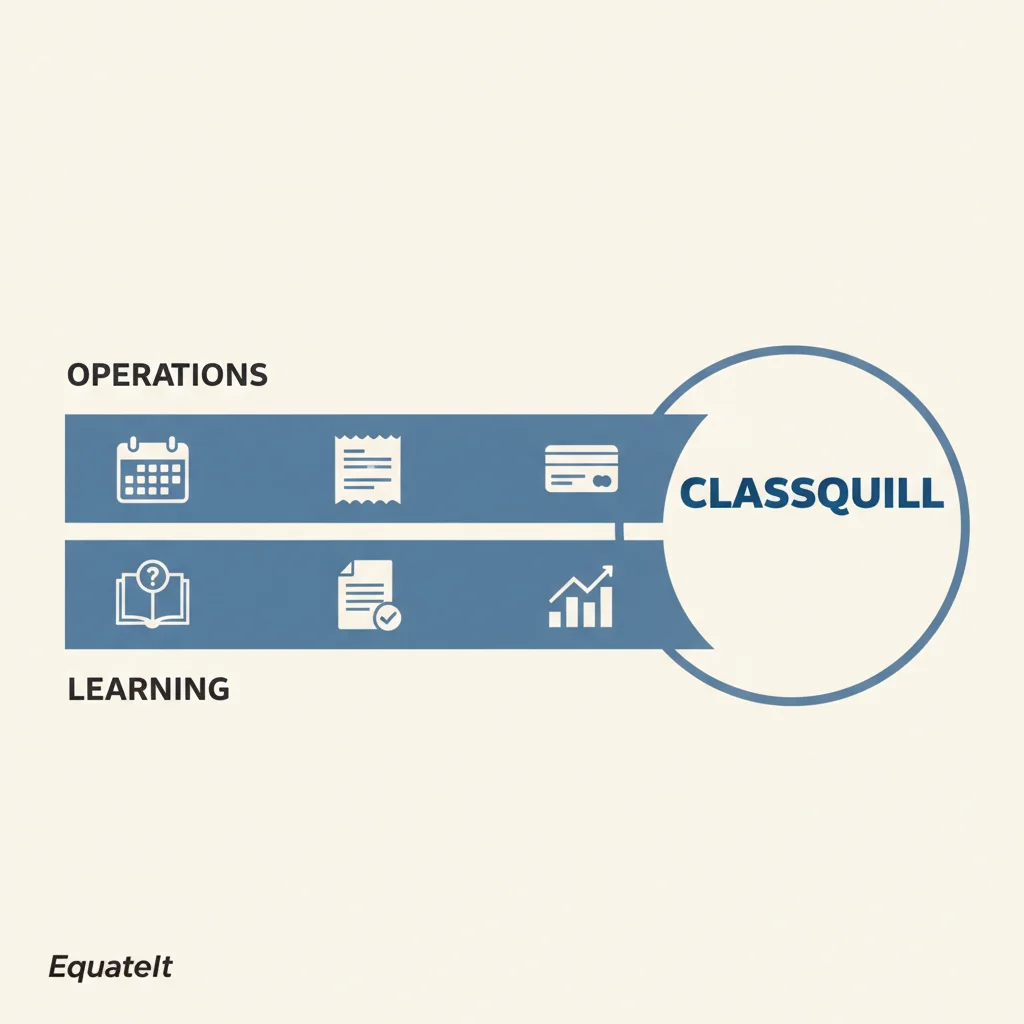
There is no single best — it depends on which problem is actually costing you money. For pure operations (scheduling, invoicing, payroll) TutorCruncher is the benchmark, Teachworks is the flexible workhorse, and TutorBird is the simplest place to start. But every one of those tools answers “did the session happen?” — none of them answer “is the student actually learning?” That second question is the one parents cancel over, and it’s the gap ClassQuill (full disclosure: our product) was built to fill, as a learning-visibility layer that sits on top of the ops stack you already run.
I run a tutoring company in Australia. Below is what I found when I went looking for software to run it — what each tool is genuinely best for, where it’s strong, and the honest gap.
How did I judge these five tools?
I’m not a software reviewer. I’m an operator — I run EquateIt, a tutoring company in Victoria, so I was buying for myself before I ever thought about building anything. That shapes what I weighted:
- Does it reduce admin without creating new admin? Ops tools earn their keep or they don’t.
- Does it work in Australia? WWCC verification for tutors, BECS direct debit, GST-compliant invoicing — table stakes here, an afterthought for overseas tools.
- Does it tell me whether students are improving? Not “did 200 sessions run” — whether those sessions produced learning I can show a parent.
- Will my tutors actually use it? A tool tutors resist is shelfware.
The first two are ops questions. The last two are learning questions — and that split is the whole story of this category.
I’ve been hands-on with all four of the ops tools below — TutorCruncher, Teachworks, TutorBird and Wise.live — signing up, exploring the actual workflows and comparing feature-for-feature, as part of building ClassQuill. Of the four, Wise.live came out strongest overall. But none of them do what building ClassQuill made obvious was missing: none are built for the Australian curriculum, none generate questions or plan worksheets, and none combine a TMS with an LMS the way ClassQuill does — they’re operations tools, full stop, not a teaching platform with operations attached.
TutorCruncher — best for operations at scale
Best for: Established companies whose primary pain is admin — invoicing, payroll, accounts — especially with UK billing requirements.
TutorCruncher has been in this market for over a decade and 1,800+ businesses globally run on it. For pure operations it’s hard to beat: automated invoicing and payroll (set the pay rates once and it calculates what each tutor is owed and what each client owes), direct Xero and QuickBooks integration, GoCardless and Stripe for direct-debit collection, a functional CRM and prospect pipeline, and TutorCruncher Video so you don’t need a separate Zoom licence. Pricing is public — three tiers at £25, £60 and £200/month — which I respect; you know what you’re paying before you sign up.
The honest gap: TutorCruncher knows your company ran 200 sessions last month and who paid for them. It cannot tell you whether those sessions produced any learning, which students are at risk of cancelling because they’re not progressing, or which tutors are actually effective. Its own community has flagged this for years — analytics were announced, delayed, and as of now still aren’t shipped. It’s also UK-origin, so the Australian specifics (WWCC, AU GST) aren’t its native turf.
Full breakdown: ClassQuill vs TutorCruncher →
Teachworks — best for flexible, customisable operations
Best for: Companies that want a configurable ops platform and don’t mind setting it up.
Teachworks is a Canadian (Kitchener, Ontario) tutoring-business management tool covering the operational core — scheduling, invoicing, payroll, and multi-tutor management. Three tiers, all with unlimited students, teachers and user accounts: Starter (US$16.49/mo + US$0.32 per student-lesson), Growth (US$47.99/mo + US$0.189 per student-lesson, adds API access and the full integration catalogue), and Premium (US$187.99/mo + US$0.065 per student-lesson, bundles 5 branch accounts). Higher tier, lower per-lesson cost — the breakeven point depends on your lesson volume. 21-day free trial, no card. It has no built-in video room — you connect your own Zoom, Google Meet or Skype, or add Lessonspace for a dedicated online classroom.
The honest gap: Same structural one as the rest of this group — it runs operations, not learning visibility. It will schedule the session and invoice for it; it won’t tell you whether the student understood the work or show a parent the evidence.
Full breakdown: ClassQuill vs Teachworks →
TutorBird — best for solo tutors and small setups getting started
Best for: Solo tutors and small operations that want a simple, affordable booking-and-billing tool without much setup.
TutorBird is Canadian (Burlington, Ontario, founded 2014) and pitched at the lighter end of the market: US$16.95/mo for the first tutor plus US$4.95/mo for each additional tutor or staff member, with unlimited students and storage, SMS reminders, website hosting and support all included — a transparent, affordable structure. It also ships its own built-in drag-and-drop website builder with mobile-responsive templates and branded registration forms, which none of the other tools in this list offer — a genuine edge if you don’t already have a site. 30-day free trial, no card. If you’re a solo tutor who mainly needs a tidy booking page and simple invoicing, it’s a sensible, cheaper starting point.
The honest gap: No built-in video, and — like the others — no learning-outcomes layer. It tracks bookings and payments, not whether students are getting better. It’s also not built for Australia, so WWCC and BECS aren’t native.
Full breakdown: ClassQuill vs TutorBird →
Wise.live — best for live-class delivery
Best for: Companies running live online classes who want delivery and operations in one place.
Wise.live is US-based (San Francisco, founded 2020) and combines class delivery with the operational side, which makes it appealing if online live teaching is the core of how you work — its own “Lens” video stack is built in (with Zoom as an alternative), the only tool in this roundup with genuinely native video. Pricing is per seat: online sessions at US$49/seat or US$95 for a 50-session bundle, in-person at US$29/seat or US$40 for 50 sessions — sold via demo and custom quote rather than self-serve signup. Of the four ops tools reviewed here, this is the one I rated highest overall after exploring it directly.
The honest gap: This is the cleanest example of the category-wide blind spot, and it’s documented in their own product. Wise.live tracks whether sessions happened, not whether students learned — its own docs send customers to third-party tools for assessment. So you can run the class beautifully and still have no answer when a parent asks “is my child actually improving?” And like every tool in this roundup, it isn’t built for the Australian curriculum and has no question-generation or worksheet-planning layer.
Full breakdown: ClassQuill vs Wise.live →
ClassQuill — the learning-visibility layer the ops tools lack
Full disclosure: ClassQuill is our product. I’m not going to rank it #1 against the tools above, because for the job most of them do — operations — they’re more mature and several are cheaper to start with. ClassQuill solves a different problem, and the honest framing is that it sits on top of your ops stack rather than replacing it.
The premise: the biggest reason tutoring businesses lose clients isn’t bad admin — it’s that parents can’t see the evidence their child is learning, so they cancel when money gets tight. Operations software can’t fix that, because it was never built to. Here’s what ClassQuill puts in front of you that the ops tools don’t:
- Tutors walk into every session knowing exactly where each student dropped marks. Before each session, the tutor sees where the student lost marks last time — pulled from marked homework and practice exams already in the system, not from inconsistent handwritten notes.
- Homework that marks itself. Tutors set homework once from a curriculum-aligned question bank — VCE, HSC and the ACARA F–10 curriculum{target=“_blank”}, not just one state — students submit; results are auto-marked and feed straight into the student’s mastery profile. No red pen, no manual entry.
- Lesson plans built from the same curriculum data as the homework. Tutors get an AI-assisted lesson plan before each session pulling from the same bank, so prep and homework aren’t two disconnected jobs.
- See which students are falling behind before they cancel. Topic-by-topic mastery tracking across every student, so the at-risk ones are visible while you can still do something about it.
- Professional parent updates with no extra effort from your tutors. Weekly progress that parents can read — what was covered, where the student is strong, where they’re slipping — generated from real session and homework data, not written by hand.
- Quality control across every tutor, at scale. For a company with 10+ tutors, consistency is the hard part. ClassQuill gives owners a view across every student and every tutor — who’s running sessions well and who needs support.
- A learning platform students actually use between sessions. An AI tutor gives curriculum-grounded answers 24/7, so fewer “I couldn’t reach my tutor” gaps turn into cancellations.
And because we’re Australian and built this to run our own AU tutoring company, the local specifics are native rather than bolted on: WWCC verification inside tutor onboarding, BECS direct debit via Stripe, and a Daily.co video room built in. Pricing is public and simple: A$19/tutor/month (Founding Partner rate, grandfathered — rising to A$39/tutor/month as the product matures), students free and unlimited, plus an optional AI+ add-on (A$5/A$4/A$3 per active student by volume) you can resell to families. A solo tutor with 15 students pays A$19/mo; a 12-tutor centre with 120 students and AI+ switched on for 80 of them pays A$628/mo. 30-day free trial, no card required, 0% taken on payments/payouts, no lock-in contract. (Free tool: pricing estimator → if you want to work out your own family rate before comparing software costs.)
More on the learning-visibility layer: ClassQuill’s learning platform →
At a glance
| TutorCruncher | Teachworks | TutorBird | Wise.live | ClassQuill | |
|---|---|---|---|---|---|
| Operations (scheduling, invoicing, payroll) | YES | YES | YES | YES | YES |
| Built-in video | YES | NO (Zoom/Meet/Skype or Lessonspace add-on) | NO | YES (own “Lens” stack + Zoom) | YES (Daily.co) |
| Public pricing | YES (£25–200/mo) | YES (US$16–188/mo + per-lesson) | YES (US$17/mo + US$5/extra tutor) | YES (US$29–95/seat) | YES (from A$19/tutor/mo) |
| Australia-native (WWCC, BECS, GST) | NO (UK-origin) | NO (Canada-origin) | NO (Canada-origin) | NO (US-origin) | YES |
| Curriculum-aligned question bank (VCE, HSC, ACARA F–10) | NO | NO | NO | NO | YES |
| Auto-marked homework | NO | NO | NO | NO | YES |
| AI-assisted lesson planning | NO | NO | NO | NO | YES |
| Student mastery tracking | NO | NO | NO | NO | YES |
| Parent progress portal | NO | NO | NO | NO | YES |
| AI tutor (between sessions) | NO | NO | NO | NO | YES |
| Tells you if students are learning | NO | NO | NO | NO | YES |
All facts above verified 2026-07-06 against the EquateIt B2B Pricing — Competitor Research note (Obsidian, last verified 2026-07-03) and vendor sites directly (teachworks.com, tutorbird.com, wise.live).
So which should you choose?
The split is cleaner than the marketing makes it look. Ask yourself which problem is actually costing you clients:
- If your pain is admin — invoicing, payroll, accounts, scheduling — pick the ops tool that fits your size. TutorCruncher for scale and accounting integrations, Teachworks if you want flexibility, TutorBird if you’re small and want simple, Wise.live if live online classes are your core.
- If your pain is retention — parents cancelling because they can’t see their child improving, or no way to keep quality consistent across tutors — no amount of better invoicing fixes that. That’s the learning-visibility gap, and it’s the one ClassQuill was built for.
Most established companies have already solved ops. If that’s you, the honest answer is that you don’t need to switch ops tools — you need the layer they don’t have. Already on TutorCruncher, Teachworks or Wise.live? They run your operations. ClassQuill shows you whether students are actually learning — and it sits on top, it doesn’t replace them.
If you’re an Australian tutoring company tired of software that can’t answer “are my students improving?”, that’s worth a 20-minute look. Book a demo →
Related reading: