A Stanford RCT Tested Whether AI Could Make Tutors Better. Here's What They Found.
I remember getting stuck trying to explain a concept I knew cold.
A student. Basic algebra. 2y = x, find y. I understood the answer. I understood why the answer was right. But in that moment, I couldn’t find the explanation that would land — the way in to the idea that would make the operation make sense to them rather than just make sense to me.
That’s not a skill gap. It’s a real-time gap. Every tutor hits it, even experienced ones. The question is what you do when it happens.
In 2025, Stanford researchers ran an experiment to find out.
Does AI actually make tutors more effective?
In the first randomised controlled trial of AI in live tutoring, Stanford researchers found tutors using an AI suggestion panel improved student mastery by 4 percentage points on average — and up to 9 percentage points for their weakest tutors. The cost was $20 per tutor per year. Here’s exactly what they did, what they found, and what it means if you run a tutoring company.
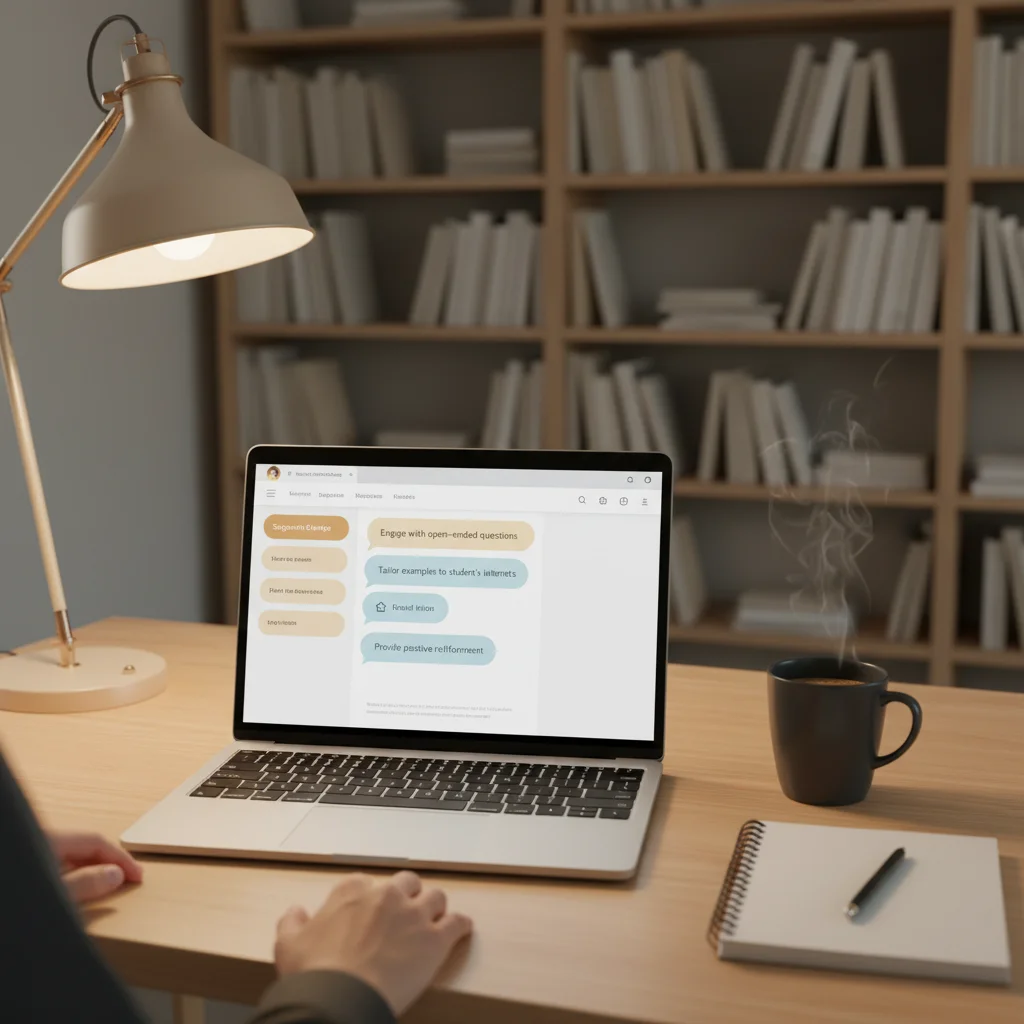
In 2025, Stanford researchers published Tutor CoPilot: A Human-AI Approach for Scaling Real-Time Expertise (Wang, Ribeiro, Robinson, Loeb & Demszky, arXiv:2410.03017). They assigned 782 tutors — across nine schools, working with 1,787 real students — to either work normally, or work with an AI panel alongside their sessions. When a tutor clicked a button, the panel generated a suggested next move: a guiding question, a hint, a worked example pitched at the student’s level. The tutor could use it, edit it, or ignore it. They were always in the loop.
This wasn’t a simulation. It wasn’t a survey. It was a preregistered randomised controlled trial — the first of its kind in live tutoring.
The outcome measure was session-level mastery: the percentage of students who passed an exit ticket at the end of the session. Hard to game. Simple to interpret.
The numbers
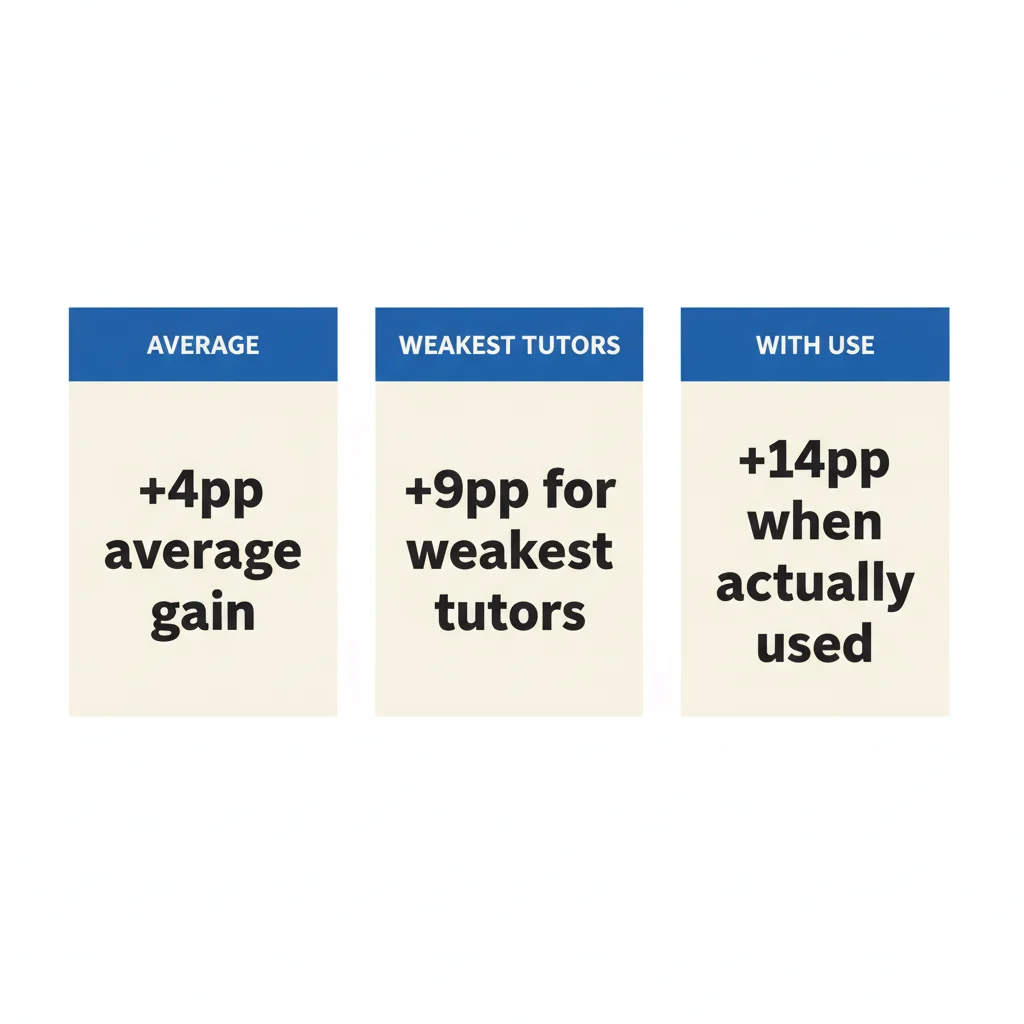
Tutors with the AI panel: +4 percentage points on exit ticket pass rates versus control (p<0.01).
For tutors who were already rated less effective at the start of the study: +9 percentage points.
When researchers looked only at sessions where a tutor actually used the panel — clicked the button at least once — the gain was +14 percentage points.
Cost: $20 per tutor per year.
For context: traditional teacher professional development programs cost $3,300+ per teacher annually and have weaker evidence of impact.
Why did it work? Tutors stopped giving away the answer
The researchers used NLP classifiers across 550,000 chat messages to compare what tutors in each group actually said.
Treatment tutors — those with the AI panel — showed consistent shifts in behaviour:
- They asked more guiding questions
- They prompted students to explain their own reasoning more often
- They affirmed correct attempts more consistently
- They gave away the answer or solution strategy less
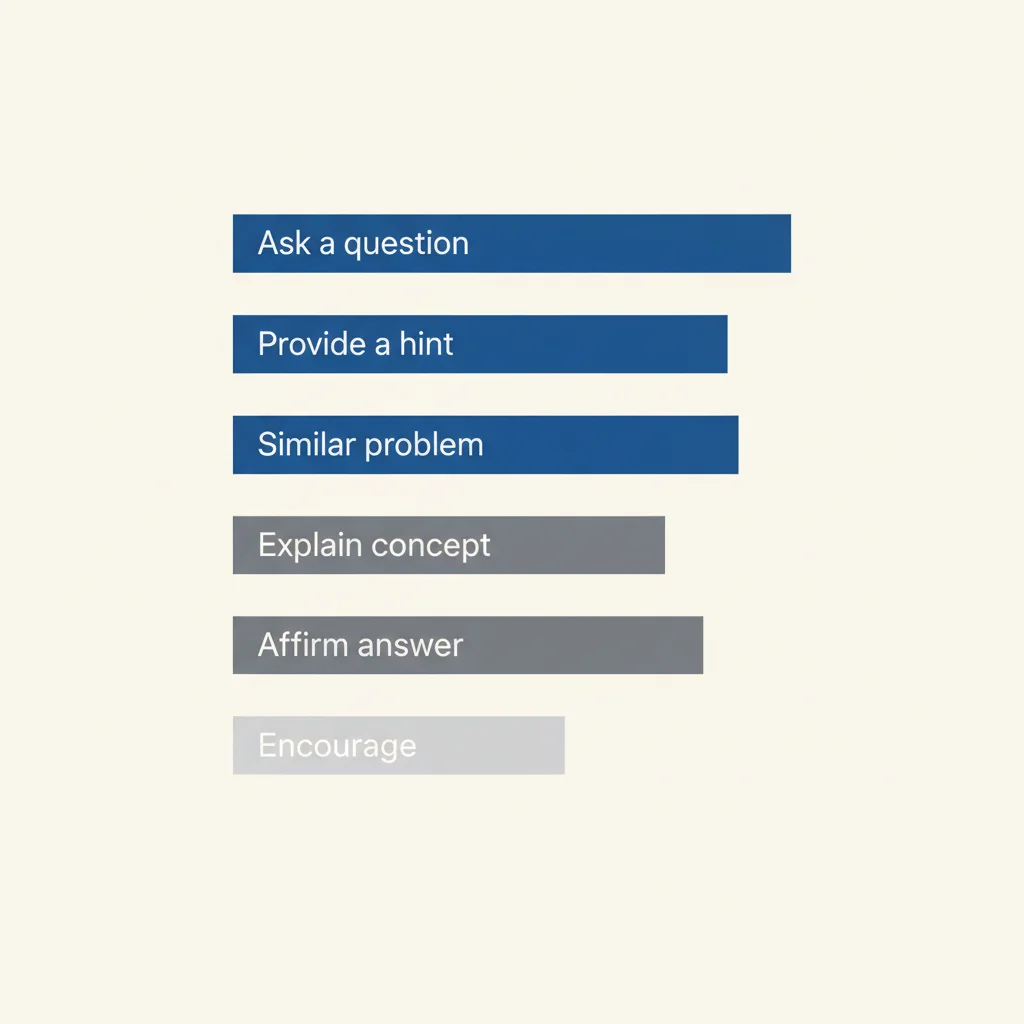
That last point is the critical one. The most common failure mode in tutoring isn’t ignorance — it’s explanation. When a student is stuck, a tutor’s instinct is to explain. But explanation is passive reception. The student hears the answer without retrieving it themselves. Nothing embeds.
Asking a question forces the student to think. A hint gives them the next step without handing them the whole path. These are the moves that build durable memory — and they’re also the moves that are hardest to produce on the spot when you’re in the room with a student who’s lost and looking at you.
That’s the gap the AI fills. Not the tutoring — the prompt.
What was the biggest finding? Novice tutors with AI matched expert tutors without it
Students of lower-rated tutors in the treatment group performed at or above the level of students with higher-rated tutors in the control group.
Read that again: a newer tutor with an AI panel delivered equivalent outcomes to an experienced tutor working alone.
This is significant if you run a tutoring company. Your quality ceiling isn’t the average of your tutors — it’s your best tutors. And you can’t clone them. You can, however, give every tutor access to the moves your best tutors make instinctively, in real time, when it matters.
What ClassQuill built from this
When this paper was published, it was the clearest evidence we’d seen that AI-assisted tutoring wasn’t just a promising idea — it was a measurable lever with a real RCT behind it. We’re committed to building on the leading edge of what the research actually proves, not what EdTech marketing claims. That means when a finding this significant comes out of Stanford, we don’t wait for it to become industry standard. We build it.
The TutorCopilot panel in ClassQuill is built directly on this research, so that every tutoring company using ClassQuill can offer their tutors the same advantage the Stanford study measured. During a live session, a tutor can request a suggested next move — a guiding question, a hint, a way to break down a concept they’re struggling to make land. The panel doesn’t teach the student. It prompts the tutor.
The tutors in the study flagged one consistent benefit in interviews: the AI was especially good at “breaking down complex concepts on the spot” and “handling difficult topics.” That’s the real-time gap it fills — not replacing the tutor’s expertise, but giving them a better prompt at the exact moment it’s hardest to find one themselves.
What this means for your tutoring business
If you have tutors who are inconsistent — good some days, flat others — the research points to what’s actually happening. It’s not that they don’t know the content. It’s that knowing content and explaining it well in real time are different skills, and the second one is harder to develop than the first.
The AI doesn’t replace the development. But it makes the ceiling accessible to every tutor on your roster, right now, in every session.
At $20 per tutor per year, the ROI case is simple. The harder question is: how much are inconsistent sessions costing you in student retention?
If you want to see how ClassQuill implements this in practice, book a free demo.
ClassQuill is tutoring management software built on peer-reviewed research — lesson delivery, question generation, and the TutorCopilot panel in one place. See how it works →
Research reference
Wang, R. E., Ribeiro, A. T., Robinson, C. D., Loeb, S., & Demszky, D. (2025). Tutor CoPilot: A Human-AI Approach for Scaling Real-Time Expertise. arXiv:2410.03017. https://doi.org/10.48550/arXiv.2410.03017